
Good Grief!
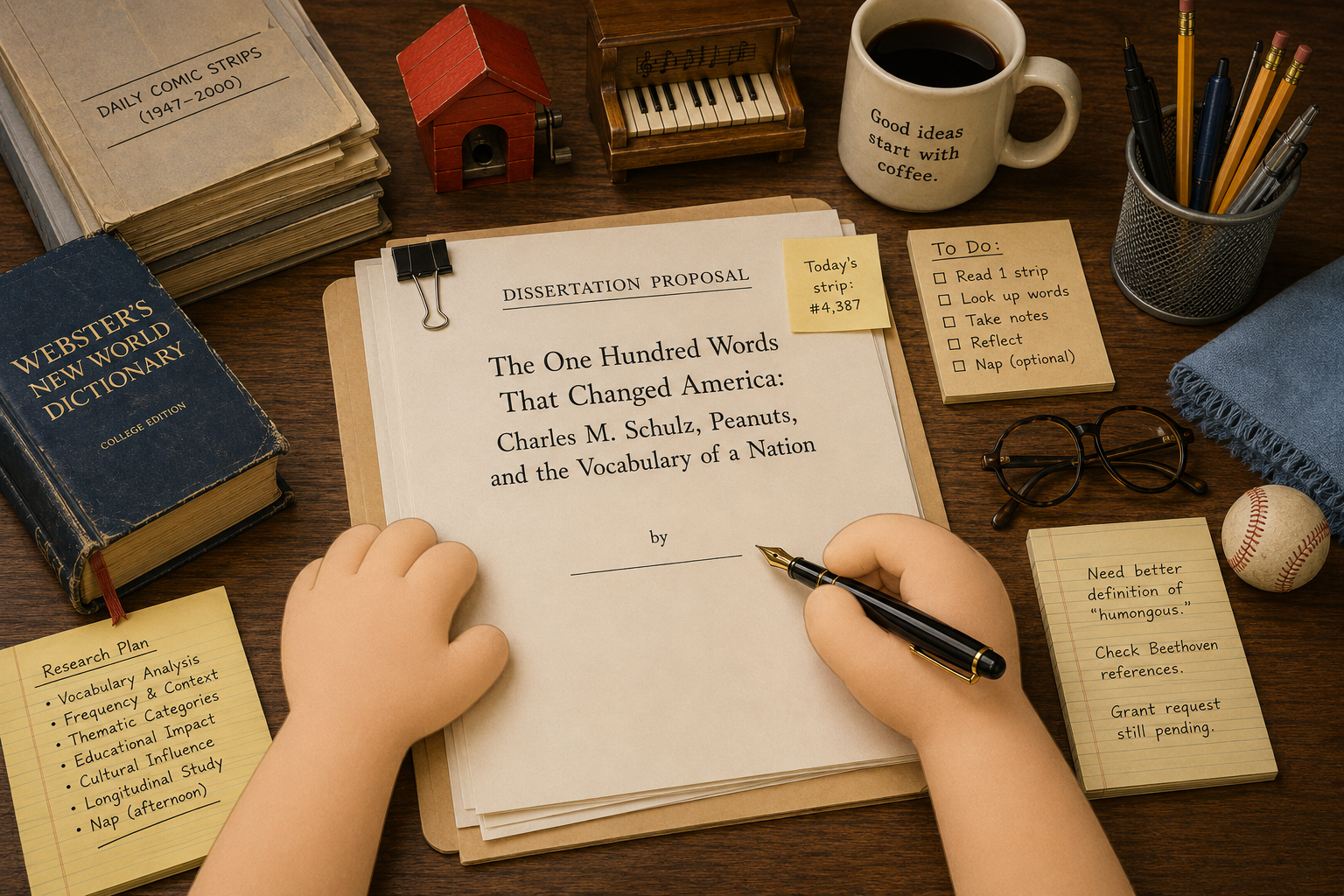
I’ve decided to submit a doctoral research proposal on the Peanuts comic strips. Hang with me and I’ll explain.
When I was a kid, my mom had a standing deal with me: she’d buy me any book at the local Gemco as long as I actually finished it. So, in my sneaky little way, I always chose the latest Peanuts collection. She’d just laugh, but a deal was a deal, so over the years I read them all.
Those books taught me to read. They used humongous words—or at least they seemed humongous to my young mind. Charles Schulz never simplified his vocabulary for children.
The themes weren’t exactly childish either. Lucy was a bossy psychiatrist. Linus had security blanket issues. Charlie Brown wrestled with chronic self-doubt. Snoopy was the free spirit we all loved. Those are things every child understands, even if they don’t yet have the language to describe them. Schulz quietly gave us the words.
Then there were the classics. Beethoven, Bach, Shakespeare, and Dickens mixed with baseball, hockey, Halloween, and the Red Baron. They simply wandered through the comic strip as though every child ought to know who and what they were.
A lot of people have written about how Peanuts helped them learn to read. But while reflecting on this over a glass of wine, I found myself wondering: has anyone ever seriously studied how Schulz accomplished that? Or what the long-term effects might have been?
Which led, naturally, to the following doctoral proposal.
Dissertation Proposal
Working Title: The One Hundred Words That Changed America: Charles M. Schulz, Peanuts, and the Vocabulary of a Nation
This dissertation will identify the one hundred words in Charles M. Schulz’s Peanuts that most challenged young readers and examine how those words quietly shaped the intellectual development of several generations of Americans.
For millions of children, Peanuts was encountered long before college, and often before many of the books now considered essential to a liberal education. Schulz assumed his readers were capable of encountering unfamiliar language without having it explained to them. Instead, children were invited to puzzle over words, ask questions, consult dictionaries, and gradually acquire a vocabulary that included ideas from psychology, theology, philosophy, literature, classical music, and everyday adult conversation.
The project will identify these one hundred words, trace their appearance across the comic strip, and argue that they served as an informal curriculum in cultural literacy. Finally, the dissertation will demonstrate that this unnoticed educational enterprise exerted a measurable influence on American intellectual and cultural life over the past seventy-five years.
The findings will establish, once and for all, that the most influential reading curriculum of the twentieth century was not found in the classroom, but on the daily comics page.
Given the scope of the proposed research, I respectfully request funding sufficient to permit a full-time examination of the Peanuts corpus.
The complete body of work consists of 17,897 daily and Sunday comic strips. In the interest of methodological rigor, I propose to examine no more than one strip per day. Such a pace will minimize interpretive fatigue, reduce the risk of premature conclusions, and allow adequate time for reflection, annotation, lexical analysis, historical contextualization, and occasional afternoon naps.
At this rate, the primary research phase will require approximately forty-nine years.
Accordingly, I request salary support, office space, research materials, conference travel, and comprehensive benefits for the duration of the project. Because scholarly breakthroughs cannot be rushed, annual renewal should be considered automatic upon submission of a brief progress report confirming that another comic strip has, in fact, been read.
Should the funding agency determine that a forty-nine-year award exceeds its customary grant cycle, I would be willing to accept an initial five-year pilot grant. During this period I anticipate completing approximately 1,826 strips and producing a preliminary paper tentatively titled The Semiotics of Snoopy’s Eyebrows: Early Findings from a Longitudinal Investigation.
While some may question the scale of this request, I would remind the committee that truly transformative scholarship requires patience. Rome was not built in a day, and neither was Charlie Brown’s self-esteem.
Now all I need is a sympathetic university, a dissertation advisor with a sense of humor, and a funding agency willing to play the long game. And hopefully nobody figures out I used AI for the proposal.
Bonus points if my advisor likes beagles.