
Much Ado About … Nothing?
We have an uncanny ability to take symbols that point toward truth and slowly convince ourselves that the symbols are the truth.
Here’s why I say that.
A big theme of my writing is that we are called to love one another. It feels to me like that sums up a lot of what Jesus was trying to teach. And if we actually practiced it, I think it could change the world.
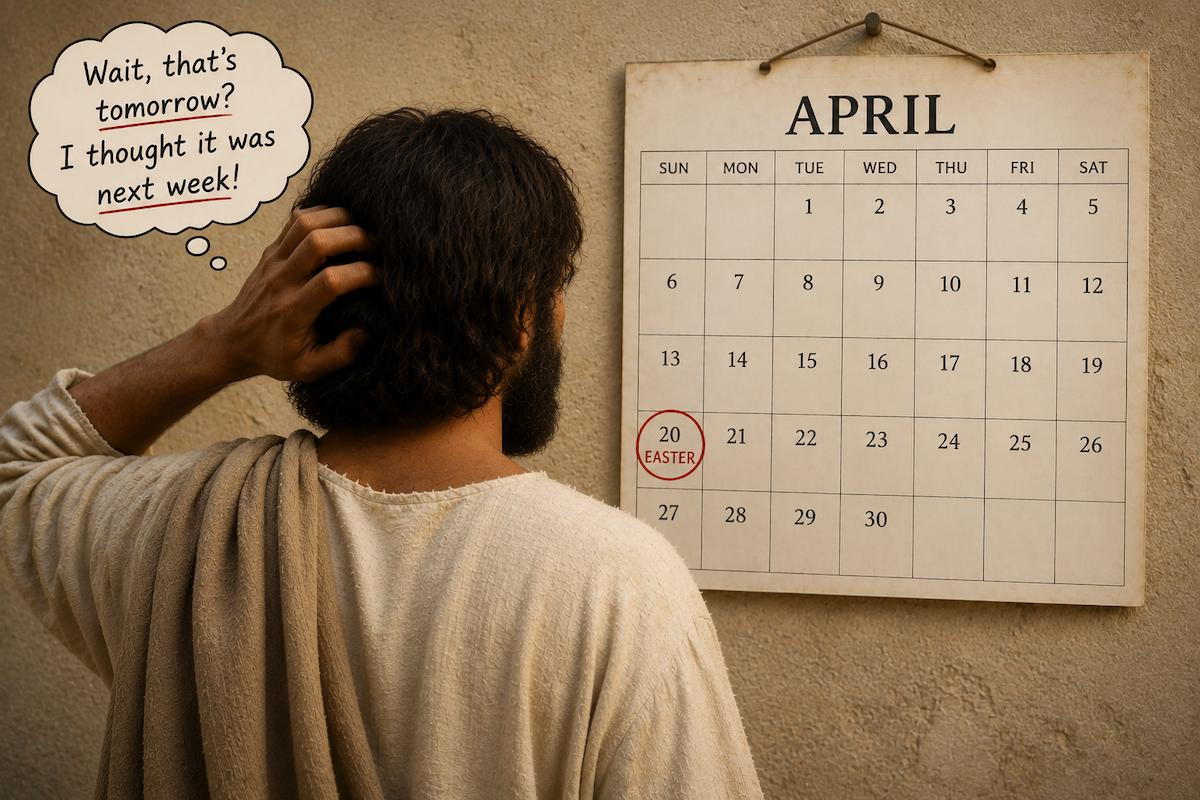
Which is why I sometimes have to laugh at the things Christians have argued about through the centuries. For instance, one of the great debates of the seventh century centered on… a calendar. More specifically, it centered on when Christians should celebrate Easter.
The Celtic churches and the Roman church used different methods for calculating the date. The arguments became heated enough that church councils were convened, letters were written, and people took sides. No doubt the seventh-century version of cable news helped keep the controversy alive.
Looking back nearly fourteen centuries later, it’s hard not to smile. “Really? This is what everyone was arguing about?” I’ve always found those stories amusing because they remind me how easy it is to turn secondary issues into primary ones.
Then I realized we haven’t changed much.
A few years ago, I wrote a daily devotional throughout Advent. A few months after Advent I did the same thing for Lent. By the time Easter morning arrived, readers had read nearly seventy of my devotions.
Those devotions were unmistakably centered on Jesus and filled with Scripture. Of course, they were also filled with the kinds of things you’d expect from me: made-up stories, Jesus eating ice cream, old junkyard illustrations, and more than a little snark. In other words, they sounded like me.
On Easter morning I opened with a simple invitation to imagine the world waking up after the resurrection. I wrote something like, “Imagine waking up on 1 CE. The world has changed.”
One reader was furious. She told me I couldn’t possibly be a follower of Jesus. Not because of anything I wrote about the resurrection. Not because I questioned Scripture. Not because I denied who Jesus was.
Her conclusion rested on one thing. I had written “CE” instead of “AD.”
Think about that for a minute. She had read nearly seventy days of my reflections about Jesus and concluded that one calendar abbreviation outweighed all of it.
The irony, of course, is that CE and AD use exactly the same numbering system. They point to the same place in history. The only thing that changes is the label. You can certainly have a preference. That’s a perfectly reasonable conversation.
But to make it a test of someone’s faith?
It struck me that perhaps we haven’t stopped arguing about calendars after all. The details have changed, but the instinct hasn’t. We still have an amazing ability to take symbols that point toward truth and slowly convince ourselves that the symbols are the truth.
We do it with Bible translations. We do it with worship styles, church buildings, politics, denominational traditions, and a hundred other things. None of those are meaningless. But sometimes they begin carrying more weight than they were ever intended to bear.
A signpost matters because it points us toward the destination. But nobody reaches the destination by standing there hugging the signpost.
Maybe that’s why the old Celtic-Roman controversy has become more interesting to me over the years. Not because it teaches me how to calculate Easter, but because it reminds me how easily I can confuse the calendar with the truth.
The older I get, the more convinced I am that I should hold tightly to Jesus’ command to love one another and a little more loosely to just about everything else.
I’ve said it before, and I’ll keep saying it: It’s not my job to make you like me. It’s my job to figure out how to love you.