The Best Things I Own Are a Little Beat Up
I have an old Toyota Land Cruiser that makes me smile every time I drive it.
It shouldn’t. It rattles even at slow speeds. And it’s always at slow speed. Turning takes Olympic weightlifter strength. The air conditioning consists of hand-cranked windows. Despite all our efforts, it still has a subtle backfire when turning the engine off. Sometimes not so subtle, alerting everyone in the Starbucks parking lot that I’ve arrived.
By almost every objective measure, newer vehicles are better. They’re safer, quieter, faster, more comfortable and vastly more reliable.
But they don’t make me smile the way the Land Cruiser does.
Why is that?
I think it’s because we use the word “best” incorrectly. We tend to think best means the highest quality, the most capable, the newest, the most beautiful, the thing that performs its intended function better than everything else.
But that’s not usually how we decide what we love.
Consider a bottle of wine. I’ve had some very good wine over the years, but you’d miss the point if you asked me to name my favorite bottles. Ask me about memorable bottles, though, and that’s different. I can tell story after story.
I remember a bottle opened with friends around a table. A bottle shared on a trip. A bottle somebody had been saving and finally decided we were occasion enough to open. I remember laughter, conversation, food and the people sitting across from me.
Usually I remember the wine. But when I tell you why the bottle was memorable, I’ll tell you about the people. (Unless the wine was really bad. Then I’ll definitely tell you about the wine.)
Which brings me to a doorknob.
A few years ago we finally tore down the original house at the Goble Ranch. It was built in the 1880s, and it wasn’t built well even then. For the last fifty years we used everything, including baling wire and duct tape, to keep it going. But it was time to start over.
When we built the new house, we wanted to carry a few pieces of the old one forward.
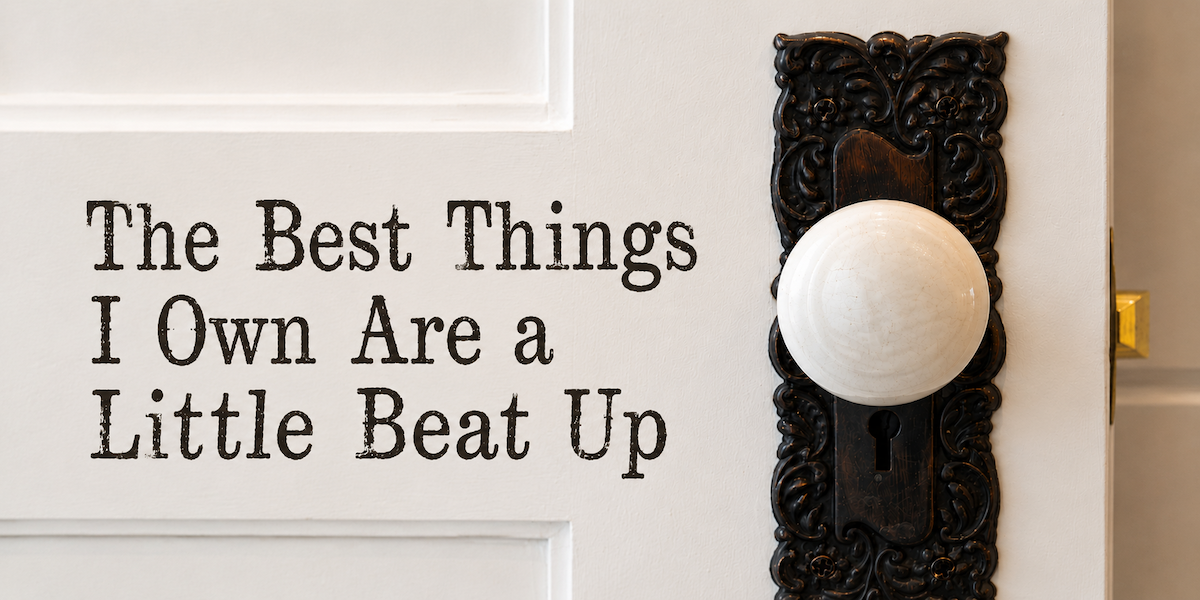
One thing we absolutely had to reuse was an original doorknob. It wasn’t from the front door, it was from the back kitchen door. Which is what everyone used. It’s porcelain and brass, which sounds fancy but can be bought online for about $20.
That old knob has been turned thousands and thousands of times.
Family members have opened that door. Friends have opened it. Kids have raced through it. People have arrived for dinner and left late at night.
Many of the people who once put their hand on that knob aren’t around anymore. My father did. My mother did. My father-in-law did. My sister did.
You can see the wear. We have to treat it gently. It’s inferior to anything at the hardware store, so it can’t be called “the best” doorknob.
But every bit of that wear came from someone opening the door. How could it not be considered the best doorknob in the new house?
That’s what an old Land Cruiser, a bottle of wine and a worn doorknob have in common. Their value isn’t primarily found in what they are. Not even in what they do. Their value comes from the experiences and relationships that gather around them over time.
I’ve written a lot about doubt recently, which naturally had me spending time with the story of Thomas. And there’s a detail in that story I can’t quite shake. The resurrected Jesus still had scars.
Think about that. Resurrection didn’t erase the scars. They remained. They were part of the story. In fact, they were how Thomas recognized Jesus.
I don’t want to make too much of that. The wounds of Jesus mean something far bigger than the scratches on an old Land Cruiser or the wear on a kitchen doorknob. But they do make me wonder if our definition of “best” needs some work.
The best things—be they doorknobs, bottles of wine, or those we love—are often a little beat up.
Not because being beat up makes them better.
Because that’s what happens when they’re part of a life.